Key Takeaways
A rushed parts purchase can create a second problem if the vehicle, component, or delivery details are wrong. Slow down just enough to identify the failure, confirm fitment, and establish a realistic delivery plan.
- Decide whether the vehicle is safe to drive or needs towing.
- Use the VIN, part number, and fitment notes together.
- Confirm physical stock instead of relying on a generic availability label.
- Give the supplier complete delivery and vehicle information.
- Inspect, test, and document the replacement before closing the repair.
Assess the situation before ordering
A breakdown creates pressure to order the first part that sounds right. Before doing that, determine what failed and whether moving the vehicle could cause more damage or create a safety risk. A few careful observations can save hours of waiting for an unsuitable component.
The most useful early details are the vehicle’s exact identity, the symptoms, and the location where the repair will happen. If a technician is already involved, ask for their diagnosis in writing or have them send a photograph of the failed part. That information gives a parts source something more dependable than a vague description.
Identify whether the vehicle is safe to drive
Start with safety rather than delivery speed. Warning lights, loss of braking or steering assistance, overheating, fuel leaks, severe tire damage, unusual smoke, or a vehicle that cannot shift normally are all reasons to stop and arrange a tow instead of attempting to reach a parts counter. Even a short drive can turn a manageable repair into a larger one.
If the vehicle is parked in an unsafe place, move it only as far as necessary and only when doing so is genuinely safe. Tell the supplier and repair shop whether the vehicle is at home, on a roadside, or already at a garage. That detail affects both the delivery address and the practical timing of the repair.
Record the symptoms and failed component
Write down when the problem began, what the vehicle did immediately beforehand, and which functions stopped working. Note sounds, smells, leaks, dashboard warnings, and whether the failure is constant or intermittent. A clear description helps separate a failed component from a related part that may only be showing the same symptom.
Ask the technician to identify the component by name and, if possible, by its stamped or molded number. Take clear photographs from several angles, including electrical connectors, mounting points, and visible labels. A complete diagnosis reduces guesswork when several parts look similar in an online catalog.
Gather the vehicle identification number
The VIN is usually the strongest starting point for confirming a vehicle’s configuration. Record all 17 characters directly from the vehicle or its paperwork rather than relying on memory. Also capture the model, model year, engine, transmission, drivetrain, and production details if they are available.
Keep the VIN beside your phone while speaking with a supplier. A typo can send the search toward a different engine, trim, or production period, so repeat the number back before payment. If the vehicle is already at a shop, ask the technician to verify it against the vehicle itself.
Find the correct Chrysler part quickly
Once the failure is understood, the task becomes a fitment problem as much as a shopping problem. A part that looks identical may differ by engine, drivetrain, connector, calibration, or production date. The fastest order is usually the one that is correct on the first attempt.
Use the vehicle information and the component information together. Search results can help locate possible parts, but they should not replace a supplier’s fitment confirmation. Keep the old component available until the replacement has been checked against it.

Use the VIN to confirm compatibility
Give the supplier the full VIN and ask for compatibility confirmation before ordering. The VIN can help narrow the catalog to the vehicle’s documented configuration, but it is still wise to discuss unusual equipment, midyear changes, or previous repairs. Mention any modifications that could affect the part being replaced.
For a Chrysler vehicle, describe the failed system as well as the model. “Front wheel-speed sensor” is more useful than “sensor,” while “right-side” is more useful than “front.” Clear terminology lets the supplier compare the VIN with the actual application rather than guessing from a broad vehicle listing.
Compare OEM, aftermarket, and used parts
The right source depends on the component, repair standard, budget, and available time. An OEM part may be preferred for certain fitment-sensitive systems, while a reputable aftermarket part can be reasonable when its specifications and warranty are clear. A used component may make sense for a body panel or discontinued item, but its condition and return terms deserve close attention.
Ask what is included in the price. A sensor may need a connector or mounting hardware, and a larger assembly may arrive without related fittings or seals. Comparing the complete package is more useful than comparing bare part prices.
Check part numbers, revisions, and fitment notes
Match the number on the failed component with the supplier’s listing, but do not assume that every number must be identical. Manufacturers and suppliers may replace an older number with a revised one, or identify an interchangeable number in a separate catalog. Request confirmation that the listed revision supersedes the original where applicable.
A simple comparison table can keep the decision grounded when several listings appear plausible:
| Check | What to compare | Why it matters |
|---|---|---|
| Part number | Original, replacement, or superseding number | Prevents ordering a related but incorrect component |
| Vehicle details | Year, engine, trim, drivetrain | Separates similar applications |
| Physical design | Connectors, mounting points, dimensions | Catches visible incompatibilities |
| Included items | Hardware, seals, brackets, wiring | Avoids a second order |
| Terms | Warranty, returns, and core requirements | Clarifies the risk of an urgent purchase |
After comparing the rows, ask one direct question: “Can you confirm this exact part fits my VIN and replaces the number I provided?” Keep the answer with the order record. It may also help the technician verify the package when it arrives.
Choose a reliable emergency delivery source
Emergency Chrysler parts delivery is not simply a matter of finding the lowest listed price. The source must have a credible path from inventory to your repair location, along with staff who can answer fitment questions. A nearby part that is genuinely available may be more useful than a cheaper part with uncertain handling time.
Consider the supplier’s communication as part of the service. A clear answer about stock, dispatch, carrier, and returns is more valuable than a vague promise of fast shipping. If the order is time-critical, call after reviewing the online listing rather than assuming every status is current.
Compare dealer, specialty supplier, and local inventory
A dealer may be useful when the part is highly configuration-specific or when factory catalog information matters. A specialty supplier may offer broader coverage for older vehicles or unusual components. Local inventory can shorten the final delivery, particularly when a repair shop or courier can collect the part directly.
Compare the whole route, not only the source location. Ask where the part is physically stored, whether it must be transferred between facilities, and whether the quoted service is delivery to a business, residence, or roadside location. The practical winner is the source with the clearest route to the vehicle.
Verify stock status before placing the order
“Available” can mean different things, so ask whether the item is physically on the shelf and ready to ship. Confirm the quantity, condition, packaging, and estimated dispatch time. If the source needs to contact another warehouse first, treat that as a different timetable from same-day fulfillment.
Request a stock check immediately before payment when the repair cannot wait. Write down the name of the representative, the time of the confirmation, and any promised handling window. This record makes it easier to respond if the status changes after the order is placed.
Review delivery areas, cutoff times, and carrier options
Delivery promises depend on distance, business hours, weekends, weather, and carrier pickup schedules. Confirm the latest order cutoff, the service area, and whether expedited or local courier options actually serve your location. A supplier may deliver to a commercial address but restrict roadside delivery, so ask before choosing the destination.
The fastest delivery plan is the one that has been confirmed at both ends: the supplier knows where the part is, and the recipient knows where it can be accepted.
Once those details are confirmed, choose a destination that will remain accessible during the delivery window. A staffed repair shop is often simpler than an unattended roadside location, but only if the shop agrees to receive the package.
Place an urgent Chrysler parts order
An urgent order should still be precise. Before clicking submit or authorizing payment, assemble the vehicle details, diagnosis, delivery address, and contact information in one place. This reduces the back-and-forth that often causes delays.
Speak plainly about the deadline, but separate a requested arrival time from a guaranteed service commitment. Ask what happens if the selected carrier misses its collection window. That conversation is especially useful when the vehicle is immobilized and the repair depends on one component.
Provide complete vehicle and contact details
Supply the VIN, model year, model, engine, drivetrain, and the part number or description supplied by the technician. Include the name and phone number of the person receiving the package. For a business, provide opening hours, a dock or suite number, and instructions for reaching the service desk.
For a roadside location, provide a precise landmark, the vehicle’s position, and a phone that will remain answered. Do not assume a driver can safely find a vehicle from a highway name alone. Update the supplier if the vehicle is moved before dispatch.
Confirm the part, quantity, and total cost
Read the order back line by line. Confirm the exact component, side or position, quantity, condition, included hardware, and any required core exchange. Then ask for the complete total, including shipping, expedited handling, taxes, deposits, and possible delivery surcharges.
If two parts are needed for the same repair, ask whether they are both available and whether they can travel together. A partial shipment may not help if the vehicle cannot be repaired until every item arrives. Make sure the invoice uses the same part number and description that were confirmed during the fitment discussion.
Request written delivery and return terms
Ask for an order confirmation that states the part, price, destination, shipping method, and estimated dispatch or delivery window. Also request the return period, restocking charge, warranty terms, and procedure for an incorrect or damaged item. Verbal assurances can be difficult to reconstruct during a stressful breakdown.
Read any core-return instructions before installation. Some components require the old unit to be returned within a set period, and missing that step can affect a deposit or refund. Save the confirmation, tracking details, and messages together until the repair is complete.
Manage delivery during a vehicle breakdown
Delivery does not happen in isolation from the repair. The technician may need the vehicle moved, the shop may have limited receiving hours, and the driver may need a safe handoff point. Coordinate these details while the part is being sourced, not after the tracking status says it is nearby.
Keep one person responsible for updates when possible. Too many separate calls can produce conflicting addresses or duplicate orders. A short timeline with order time, promised dispatch, tracking events, and shop availability can make a long wait easier to manage.
Coordinate with the repair shop or technician
Tell the shop what has been ordered and when it is expected. Confirm whether the shop can receive the package, whether it has room to store it, and whether the technician needs any additional seals, fluids, fasteners, or programming after installation. These questions can expose missing items before the vehicle is apart.
Ask the technician to inspect the package against the diagnosis before beginning work. If the part is wrong, the shop may be able to keep the vehicle in a safe state while a replacement is arranged. Clear coordination protects both the repair schedule and the delivery record.
Use commercial, residential, or roadside delivery
Choose the address where someone can reliably receive and inspect the package. Commercial delivery may work well during staffed hours, residential delivery may be practical for a driveway repair, and roadside delivery requires extra care because the vehicle and recipient can move or become difficult to locate.
Give the carrier any access instructions without including unnecessary personal information. Keep the phone available, but do not stand in an unsafe traffic area waiting for a package. If conditions change, contact the supplier promptly and ask whether the destination can be updated.
Prepare for delays, damaged packages, or backorders
Have a fallback plan before the promised window expires. Ask whether another warehouse, a different condition grade, or a revised part number is available. If the package is delayed, preserve the original tracking history and avoid placing a duplicate order until you know whether cancellation is possible.
When a box arrives damaged, photograph the exterior before opening it and photograph the contents and packaging afterward. Notify the supplier promptly, even if the part appears usable. A documented condition report gives the source and technician a clearer basis for deciding whether installation should proceed.
Install and verify the replacement part
Fast delivery only helps when the replacement is installed correctly and the original fault is actually resolved. Before work begins, compare the new part with the old one and with the order confirmation. A short inspection is easier before the original component has been removed.
Follow the appropriate service procedure and involve a qualified technician when the repair affects braking, steering, restraint systems, high-voltage systems, fuel, or other safety-critical equipment. Do not force a connector, drill a new mounting hole, or modify a part simply to make it fit. Those are warning signs that the order or diagnosis needs another review.
Inspect the part and packaging upon arrival
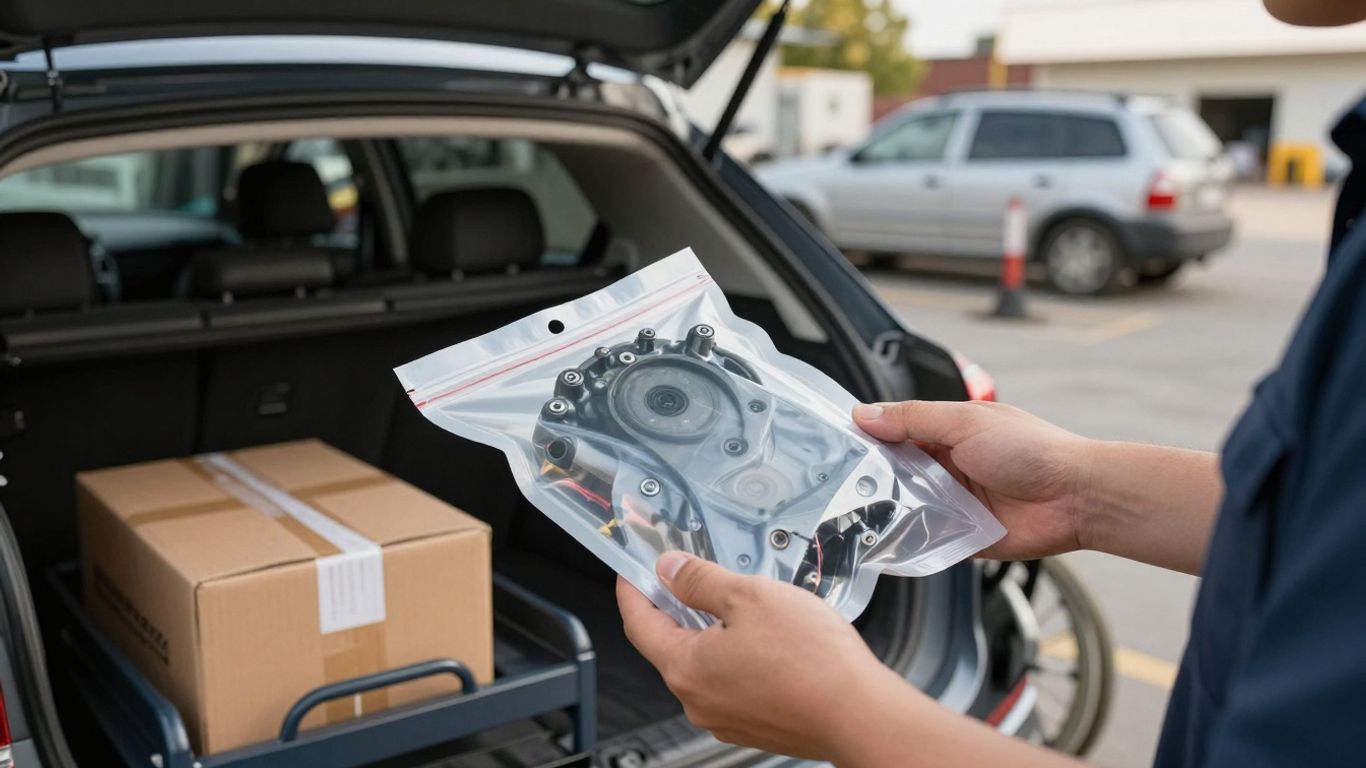
Check for crushed corners, torn seals, moisture, missing hardware, scratches, cracks, bent terminals, and signs of prior installation. Compare labels and part numbers with the invoice. Keep the box, protective material, and documentation until the repair has been tested successfully.
If the component is visibly wrong or damaged, pause before installation. Contact the supplier with photographs and a concise description of the discrepancy. Installing a questionable part can make a return more difficult and may obscure the original problem.
Confirm fitment before removing the original component
Place the replacement beside the original and compare connector shape, mounting points, orientation, dimensions, and included pieces. Confirm the vehicle side and position, especially for components supplied in left- and right-hand versions. If the original number differs, verify the supersession or interchangeability with the supplier.
A final VIN check is worthwhile when the part is expensive, difficult to access, or ordered under time pressure. Ask the technician to confirm that the replacement matches the repair order before disassembly. This small pause can prevent a vehicle from remaining disabled while another part is located.
Test the repair and keep the purchase records
After installation, test the relevant function in a controlled setting. Clear or recheck fault codes when the service procedure calls for it, inspect for leaks or unusual noises, and confirm that warning lights behave as expected. A road test should happen only when the vehicle is safe to drive and the technician approves it.
Keep the invoice, VIN confirmation, delivery record, photographs, warranty information, and any returned-core receipt. Record the installation date and mileage as well. Good records make future diagnosis, warranty claims, and maintenance decisions much simpler.
Conclusion
The quickest emergency Chrysler parts delivery is usually built on accurate information rather than frantic ordering. Identify the safety risk, confirm the part against the VIN and original component, verify real stock, and coordinate the handoff with the repair location. Those steps cannot remove every delay, but they greatly reduce the chance that an urgent breakdown becomes an avoidable second repair.