Key Takeaways
A fast, safe parts search starts with diagnosis rather than guesswork. Identify the failure, confirm fitment, and choose the repair or towing option that protects both you and the vehicle.
- Move away from traffic and avoid roadside work when conditions are unsafe.
- Use the VIN, engine, trim, and symptoms to confirm the correct part.
- Compare dealer, independent, salvage, and online availability before ordering.
- Treat brakes, tires, overheating, and fuel leaks as towing concerns when appropriate.
- Keep repair records, warranty details, and emergency supplies accessible.
Assess the breakdown before ordering parts
A vehicle that stops suddenly creates pressure to buy the first part that sounds plausible. That approach can waste time, especially when several failures produce similar symptoms. Start by protecting the people around the vehicle, then gather enough information to separate a likely diagnosis from a guess. The right part is useful only when it addresses the actual fault.
Identify whether the issue is safe to inspect roadside
Before opening the hood, consider traffic, weather, visibility, road position, and the condition of the vehicle. Move to a safe location if possible, turn on hazard lights, and keep passengers away from moving traffic. Do not inspect beneath a vehicle supported only by a jack, and do not touch hot coolant, damaged wiring, or leaking fuel.
A short visual check is reasonable when the car is secure and the problem is minor. If there is smoke, a strong fuel smell, exposed electrical damage, unstable suspension, or a risk of fire, call for help instead of attempting a roadside repair.
Check warning lights, noises, leaks, and starting symptoms
Write down what happened immediately before the breakdown. Note whether the engine cranked, whether it started and then stalled, and whether the dashboard displayed a warning light. Also look for fluid color and location, unusual smells, belt noise, grinding, clicking, or a temperature gauge that moved toward hot.
Those details help a technician distinguish a weak battery from a starter concern, or an overheating event from a simple low-fluid warning. Specific symptoms save time because they narrow the search before anyone removes a component.
Use the VIN, model year, engine, and trim to confirm fitment
A part that fits one model year may not fit another version of the same vehicle. Have the full VIN ready, along with the model year, engine size, transmission, trim, and—when relevant—drive configuration. A supplier can use that information to check catalog fitment rather than relying on a broad vehicle description.
Ask whether the replacement includes necessary seals, hardware, sensors, or mounting pieces. If the old part has a readable label or casting number, photograph it, but treat that number as supporting information rather than the only proof of compatibility.
Decide whether the vehicle needs towing instead of a quick repair
A jump-start may restore power without solving the reason the vehicle stopped. Likewise, adding coolant may get you moving briefly while leaving a serious leak unresolved. Towing is the safer choice when the engine overheated, the brakes feel abnormal, a tire or wheel is damaged, steering is impaired, or the vehicle cannot maintain safe control.
When calling, describe the failure honestly and ask whether the transporter needs a flatbed. The answer can depend on the vehicle’s drive system, damage, ground clearance, and whether its wheels can roll freely.
Find Chrysler breakdown parts urgently
Once the vehicle is safe and the likely failure is understood, search in parallel rather than waiting on one supplier. A nearby dealer may have a matching OEM part, while an independent store or recycler may offer a workable alternative sooner. For an urgent Chrysler breakdown parts urgent situation, availability matters as much as catalog fitment.

Keep the VIN and exact part description in front of you during every call. That prevents the same fitment questions from slowing down each supplier.
Contact local Chrysler dealers for in-stock OEM parts
Call the parts counter before driving to the dealership. Give the VIN and ask whether the part is physically in stock, held for another customer, or available at a nearby location. Confirm the pickup process, return conditions, and whether a core is required for the old component.
A dealer can be particularly useful when the repair involves vehicle-specific electronics, unusual hardware, or a part whose fitment is difficult to confirm from a generic catalog. Still, an in-stock promise should be verified before you arrange transportation.
Compare independent parts stores, salvage yards, and online suppliers
Independent stores can be practical for common maintenance and electrical components, while salvage yards may have assemblies or body-related pieces that are difficult to source new. Online suppliers can widen the search, but shipping time, seller quality, and return logistics become more important when the vehicle is already stranded.
Compare the complete cost, not just the listed price. Include delivery, taxes, refundable core charges, required accessories, and the possibility that an incorrect part will delay the repair.
Ask about same-day pickup, delivery windows, and after-hours service
Ask each supplier to state the earliest realistic handoff time. “Available” can mean sitting on a local shelf, arriving later that day, or being obtainable from a regional warehouse. Find out whether pickup requires advance payment and whether delivery reaches the roadside location or only a commercial address.
After-hours options may be limited, so confirm when the parts counter closes and whether a mobile technician can receive the part for you. A clear delivery window is more useful than a vague promise of speed.
Verify availability before paying for expedited shipping
Expedited shipping cannot overcome an inventory error. Request confirmation that the exact part number is allocated to your order, and ask whether the package is shipping from the stated location. If the vehicle is immobile, compare the shipping time with a local pickup or a transfer between nearby stores.
Before paying, check the cancellation policy and expected arrival date. That small pause can prevent paying extra for a package that will still arrive after a locally available part.
Choose between OEM, aftermarket, and used parts
The best replacement depends on the component, the urgency, and the consequences of another failure. An OEM part may simplify fitment, while a reputable aftermarket option can be sensible for a common repair. Used parts can also work when their condition and application are clear. The decision should balance safety, availability, warranty, and total cost rather than relying on one label.
Understand when an OEM part is worth the extra cost
An OEM replacement is often worth considering when precise fitment, electronic communication, sealing, or calibration is central to the repair. It may also make sense when the vehicle is newer, the component is difficult to return, or labor costs would make a second installation especially expensive.
That does not mean every urgent repair requires the most expensive option. Ask what difference the source of the part makes for this specific component, and whether the supplier can confirm the exact application through the VIN.
Evaluate aftermarket brands for common emergency repairs
Aftermarket parts vary by manufacturer and by component, so compare specifications rather than treating the category as uniform. Check construction, included hardware, testing information, warranty length, and whether the part is intended for the exact engine or system in question.
For a common repair, a known-quality replacement may be available faster than an OEM unit. The installer should still confirm dimensions, connectors, ratings, and any required programming before fitting it.
Use recycled or used parts without compromising safety
Used parts can be reasonable for non-safety-critical items or assemblies with a clear inspection history. Ask for mileage when it is known, the donor vehicle details, visible condition, and the yard’s testing process. Avoid guessing with components that affect braking, steering, restraint systems, or structural integrity.
A low price is not helpful if the part is damaged, corroded, or impossible to return. Photograph the replacement before installation and retain the supplier’s description in case its condition differs from what was promised.
Check warranties, return policies, and core charges
Read the terms before the part is installed. Some warranties cover the component but exclude labor, diagnosis, towing, or damage caused by another failed system. A core charge may be refundable only when the old part is returned promptly and meets stated conditions.
Use a simple comparison so the cheapest listing does not hide a costly restriction. The practical choice is often the option with a clear return path and enough coverage to protect the repair.
| Part source | Useful when | Confirm before buying |
|---|---|---|
| OEM | Fitment or electronics are unusually specific | VIN match, stock status, return terms |
| Aftermarket | A common component is needed quickly | Brand specifications, warranty, included hardware |
| Used or recycled | A serviceable assembly is hard to find new | Condition, testing, donor details, core terms |
This comparison is not a substitute for diagnosis. It simply keeps urgency from turning into an automatic choice that may not suit the failed component.
Match common Chrysler failures with likely replacement parts
A symptom points toward a system, not always a single replaceable part. A no-start condition, for example, can involve the battery, cables, starter, fuel delivery, ignition, or a control sensor. Use likely parts as a starting point for questions, then let testing determine what actually needs replacement.
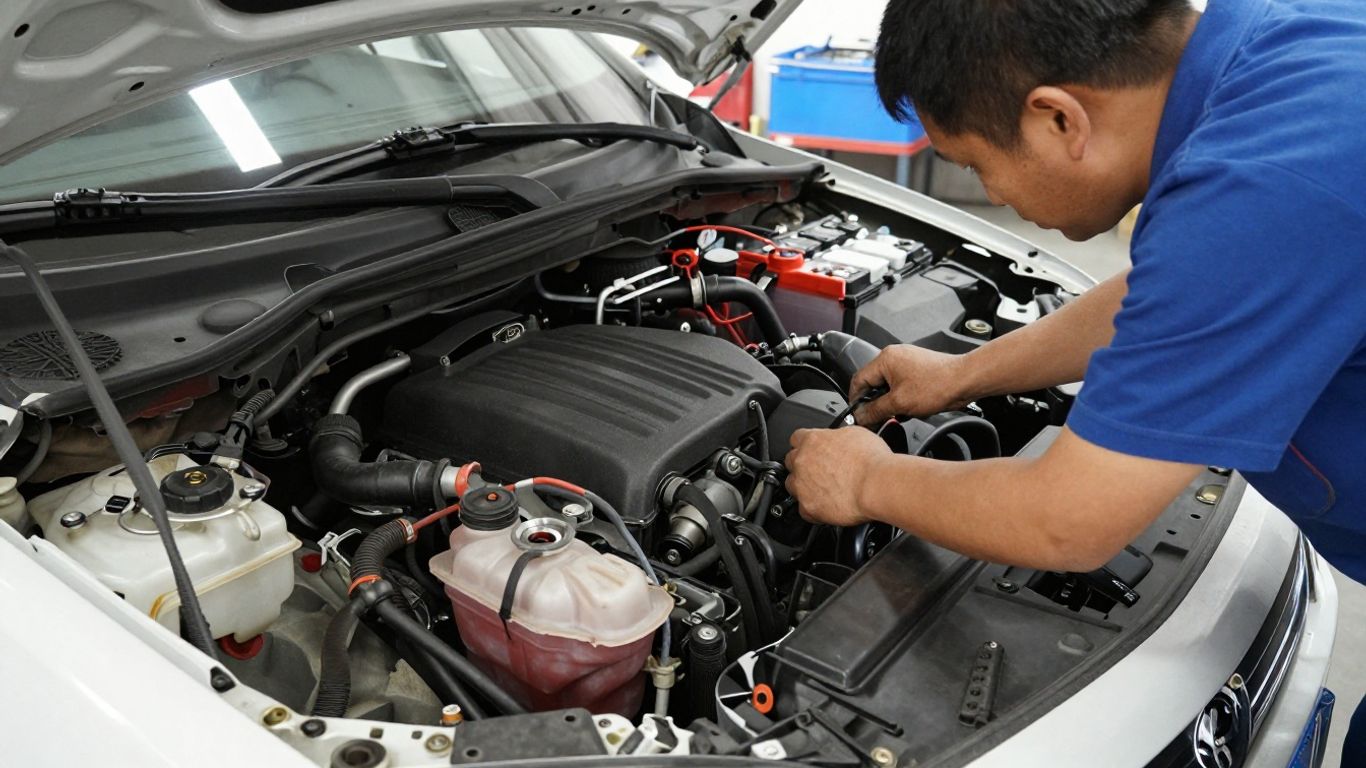
The safest repair is the one that addresses the cause rather than masking the symptom. That distinction matters most when the vehicle stopped after heat, smoke, or a warning light.
Address dead batteries, alternators, and starter motors
A rapid clicking sound may accompany low battery voltage, but a discharged battery can also result from a charging-system fault. Ask for battery and charging tests before ordering a battery, alternator, or starter. Inspect the terminals and cables as well, since corrosion or a loose connection can imitate a failed component.
If the engine does not crank at all, a starter may be involved, but the test results and voltage readings should guide the decision. Replacing several expensive parts at once is rarely the fastest path.
Handle overheating with cooling-system components
Overheating calls for caution before parts shopping. Possible replacement needs include a hose, thermostat, radiator, water pump, fan-related component, cap, or belt, but the visible symptom may come from a leak or a failed control signal. Never remove a pressurized coolant cap while the engine is hot.
Allow the system to cool and look for obvious leaks from a safe position. If coolant is rapidly escaping, the temperature rose sharply, or steam appeared, arrange a tow rather than relying on a refill and continued driving.
Repair brake, tire, and suspension problems safely
Brake fluid loss, a soft pedal, grinding, a damaged tire, a bent wheel, or sudden pulling can make the vehicle unsafe to move. Potential parts may include pads, rotors, a hose, a caliper, a tire, a wheel, or suspension hardware, but the complete system needs inspection.
Do not substitute a temporary roadside fix for a brake or steering repair. A mobile technician may be able to assess the issue, yet a shop or tow is often necessary for lifting, alignment, torque checks, and a controlled road test.
Troubleshoot fuel, ignition, and sensor-related breakdowns
A crank-but-no-start condition can involve fuel pressure, an ignition component, wiring, a relay, or a sensor. Strong fuel odor, a visible leak, or repeated stalling raises the safety risk. Avoid repeated starting attempts when fuel may be accumulating or when electrical damage is visible.
A scan result can identify a stored fault code, but the code does not automatically name the failed part. Combine scan data with symptoms, wiring checks, and basic system tests before ordering a replacement.
Coordinate roadside repair or towing
Good coordination reduces delays once help is on the way. The technician or tow operator needs a safe access point, accurate symptoms, and enough vehicle information to plan equipment and parts. Keep communication factual, especially if the vehicle has already been partially disassembled or jump-started.
A short call can prevent a second trip. It can also reveal that the required repair is beyond what can safely be done at the roadside.
Give the technician accurate vehicle and symptom details
Provide the VIN, mileage if known, warning lights, recent repairs, weather conditions, and the exact sequence of events. Say whether the engine cranks, whether the vehicle moves, and whether there is smoke, leakage, or unusual noise. Avoid diagnosing the failed part as a certainty unless testing has already confirmed it.
These details help the technician bring suitable equipment and decide whether a mobile assessment is appropriate. Honest uncertainty is more useful than a confident but incorrect parts request.
Prepare the part number, location, and access information
Send the supplier’s part number, a photo of the old component, and the vehicle’s precise location. Include parking-garage height limits, roadside direction, nearby landmarks, gate instructions, and whether the keys are accessible. If the vehicle is in a dangerous position, say so immediately.
When a part is already waiting at a store, share its address and pickup requirements. The technician can then decide whether to collect it, have it delivered, or recommend a different source.
Confirm labor rates, mobile-service fees, and towing charges
Ask for the diagnostic fee, hourly labor rate, mobile-service charge, parts markup, after-hours rate, and towing cost before authorizing work. Also ask whether taxes, storage, mileage, winching, or disposal fees could apply. A written estimate is preferable, even when the first assessment is made by phone.
A low initial quote may exclude a charge that appears later. Clarifying the pricing structure gives you a fair basis for choosing between roadside work and transport to a shop.
Know when dealer service is safer than an on-site repair
Some repairs require specialized tools, programming, calibration, a lift, or a controlled inspection. Dealer service may be safer when the failure involves complex electronics, restraint systems, advanced driver-assistance equipment, transmission concerns, or damage that cannot be evaluated on the shoulder.
Roadside work is best reserved for repairs that can be completed securely and tested properly where the vehicle sits. If the technician cannot verify the repair, towing is the more responsible option.
A quick repair is only successful when the vehicle is safe to drive afterward.
Use that standard when deciding whether convenience should outweigh a fuller inspection. Saving one tow is not worthwhile if it leaves a hidden brake, cooling, or steering problem unresolved.
Prevent another urgent Chrysler parts breakdown
Emergency parts searches are easier when routine maintenance has not been ignored. Records reveal what was replaced, which warranties remain active, and which systems may be approaching a service interval. Prevention does not eliminate unexpected failures, but it can make them less severe and easier to diagnose.
Build a small record around dates, mileage, part numbers, and symptoms. That information becomes valuable the next time a warning light appears or a component begins to behave differently.
Follow maintenance intervals for fluids, belts, and filters
Use the vehicle’s maintenance schedule for oil, coolant, brake fluid, filters, belts, and other specified services. Inspect fluid levels and visible belt condition during routine checks, but do not treat a clean appearance as proof that a part is healthy. Age, mileage, heat, and contamination can all affect service life.
Keep receipts and note the mileage after each service. A consistent record helps a technician avoid repeating work and makes warranty conversations more straightforward.
Watch for early signs of recurring component failure
Slow cranking, dimming lights, intermittent warning lamps, temperature changes, fluid spots, vibration, and new noises deserve attention before the vehicle stops. Intermittent problems are easy to dismiss because the vehicle may seem normal again after cooling down or restarting.
Record when the symptom appears and whether it changes with rain, temperature, speed, or electrical load. Patterns can help distinguish a recurring component problem from an isolated event.
Keep essential emergency supplies and replacement information
Carry a charged phone, flashlight, reflective gear, gloves, basic first-aid supplies, and a way to record the vehicle’s location. Keep the VIN, insurance details, roadside-assistance information, and recent repair records accessible without relying on the disabled vehicle’s infotainment system.
A tire inflator or jump pack can be useful when used correctly, but neither replaces safe positioning or professional help. Do not carry out a repair simply because a tool is available.
Document repairs and use warranty coverage when available
Save invoices, diagnostic notes, test results, part numbers, warranty terms, and photographs of unusual damage. Ask the installer which component failed, what was tested, and whether another system may have contributed. Those details can prevent a repeat replacement and support a claim if the part fails again.
If a warranty applies, follow its inspection and return procedure before discarding the old component. Clear documentation gives the supplier or repair facility a better chance to resolve the issue efficiently.
Conclusion
Finding parts quickly matters, but safe diagnosis and verified fitment matter more. Protect the scene, collect precise vehicle and symptom details, compare realistic availability, and choose towing whenever the repair could affect control, heat, fuel, braking, or steering. A calm process turns an urgent breakdown into a manageable repair decision.